
5 Hand Exercises for Essential Tremor: What Actually Helps
TL;DR
- Hand tremor exercises can reduce the visible impact of tremor by strengthening the muscles around affected joints.
- Progressive resistance work has the most research support, though studies are small and results vary.
- Combine strength, fine motor drills, flexibility, and relaxation for the fullest benefit.
- Consistency matters more than intensity; short daily sessions outperform occasional long ones.
- Talk to a physician or therapist before starting, especially with a new or worsening tremor.
Can hand tremor exercises actually reduce essential tremor, or is that wishful thinking? For many people, they are among the first self-management tools they research, because writing, using utensils, and holding a glass are where tremor has its most practical impact. Not every exercise helps equally; the difference lies in mechanism and consistency. This article walks through five exercises and what each one does.
Why Exercise Affects Essential Tremor

Essential tremor originates in the brain's control of movement, and exercise does not change that neurological source. Exercise can change muscle strength and neuromuscular control around the affected joints. Stronger forearm and hand muscles create a more stable mechanical envelope, limiting how far the hand deviates when an involuntary signal fires. This is why structured hand tremor exercises may reduce visible severity over time, with the clearest results seen from progressive resistance training at appropriate intensity.
Finger Tap Exercise for Motor Control
Finger tapping trains fine motor control with no equipment and can be done anywhere. Tap each finger individually to the thumb, using both hands at once if possible: index, middle, ring, pinky, then reverse the sequence. Keep the thumb as stable as you can, since anchoring is part of the training effect. Repeated precise tapping drills the same motor neuron pathways that essential tremor disrupts, reinforcing finger coordination. It is a low-load way to strengthen the patterns behind precision tasks like writing and using utensils.
Wrist Flexion and Forearm Rotation
The wrist and forearm are the primary resistance-training zone for hand tremor. For wrist flexion, turn the palm up and bend the wrist down and back for 10 to 15 reps, adding gentle counter-pressure with the other hand. Cycle slowly between supination (palm up) and pronation (palm down). With a light 1 to 3 lb dumbbell, move the wrist up and down 20 times. Structured resistance programs over several weeks are associated with improved dexterity and strength in the most affected limb.
Grip Strengthening: Tight Fist and Rubber Ball
Grip work builds muscle tone and stimulates the motor pathways behind fine movement. For the tight fist, form a firm fist, hold for 10 seconds, release fully, and repeat 10 times each hand. With a soft rubber ball, squeeze and fully release for 10 to 15 reps. Both build the intrinsic hand muscles used for writing, gripping utensils, and fastening buttons. Grip exercises do not address the neurological origin of tremor, but they are accessible and easy to fold into a daily routine.
Thumb and Finger Stretching for Range of Motion
Flexibility work complements strength by keeping stiffness from adding to tremor-related difficulty with precision tasks. For the thumb bend, bring the thumb across the palm to the base of the little finger, hold 30 to 60 seconds, and repeat up to four times per hand. For thumb extension, wrap a rubber band around the fingers at joint level and spread the thumb away, holding up to 60 seconds, for 10 reps. Finger bends and tendon glides help maintain range of motion.
Weight-Bearing Exercises for Upper-Extremity Stability
Training the full upper extremity, not just the hand, has research support. Planks, push-ups, bicep curls, shoulder lifts, and wrist curls make the arm work against resistance, strengthening the whole kinetic chain. Published findings suggest light-load resistance produces little tremor reduction, while measurable benefit appears with progressive, heavier-load work. That does not mean heavy lifting. It means building intensity gradually, ideally under a physical therapist's guidance, starting with bodyweight variations before adding external load.
The Role of Relaxation and Stress Management
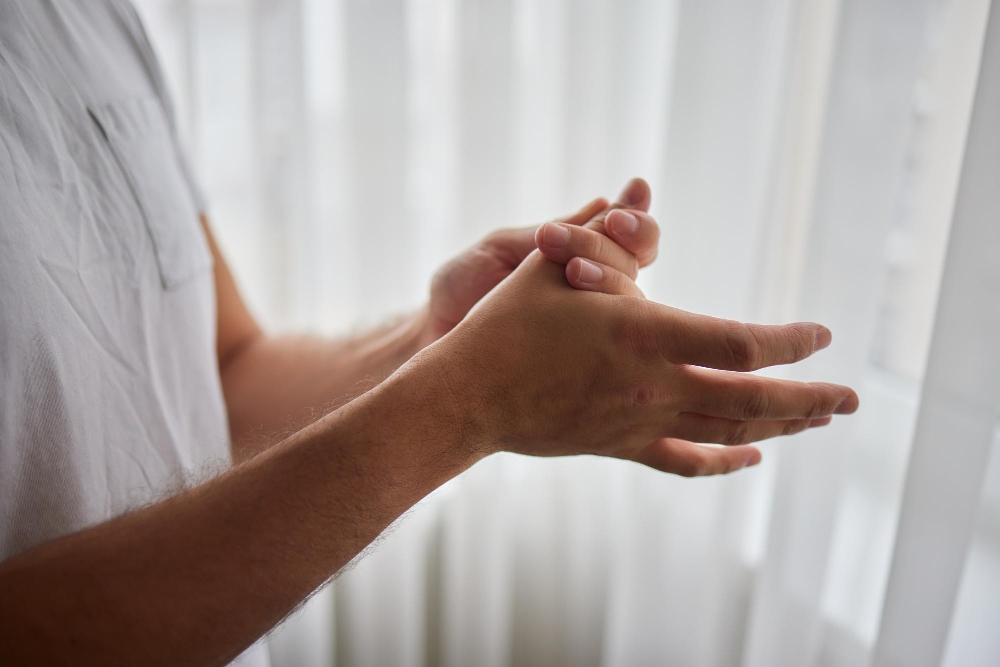
Stress does not cause essential tremor, but it reliably worsens it, which makes relaxation a genuine part of management. Physical activity releases muscle tension and helps the body settle. Yoga and tai chi appear often in clinical and patient resources for essential tremor because they combine movement, breath control, and attention, addressing both physical and stress-related triggers. Deep breathing works similarly. Relaxation-based movement helps most when practiced consistently, not only on high-symptom days.
Assistive Technology Alongside Exercise
Strength gains from hand tremor exercises take weeks to show, so many people need support for daily tasks in the meantime. The Steadi-3 Plus Anti-Tremor Glove is a battery-free, passive magnetic device clinically tested for essential tremor and Parkinsonian tremor. In clinical testing using the Fahn-Tolosa-Marín scale, 84% of participants showed improved tremor control compared to wearing no device. It is an FDA-registered Class I medical device, and Pisces Innovation is its exclusive authorized distributor in the United States. Our team can help you consider whether it suits your situation.
What Exercises Do Not Help and What to Avoid
Some approaches quietly work against you. Overexertion and physical fatigue reliably worsen tremor amplitude, so stop exercises before exhaustion.
- High-intensity aerobic exercise that raises cortisol and anxiety may temporarily spike symptoms.
- Precision tasks under time pressure, such as competitive settings, can increase performance anxiety and worsen visible tremor.
- Caffeine before a session adds unnecessary stimulation.
General movement is not the problem; intensity, recovery, and stress are. Rest days are part of the program.
How to Build a Consistent Practice at Home
Consistency drives neuromuscular adaptation, so short daily sessions of 10 to 15 minutes beat occasional long ones. A simple starting structure:
- Finger tap and wrist flexibility: about 5 minutes.
- Resistance work: about 5 minutes.
- Relaxation breathing: 3 to 5 minutes.
Progress gradually, and do not add weight until the current load feels controlled. Choose exercises that train the tasks you most want to improve, such as writing or eating. A physiotherapist or occupational therapist can adapt the routine to your needs.
When to Talk to a Doctor Before Starting
If your tremor is new or worsening, a medical evaluation should confirm the diagnosis before you begin any exercise program, since the right approach depends on it. Some medications for essential tremor, such as beta-blockers and anticonvulsants, carry cardiovascular or balance considerations that affect intensity. Joint pain or limited shoulder mobility needs individual modification. A physician can also refer you to physical therapy for a program matched to your tremor grade; what suits a Grade 1 tremor may not suit a Grade 3.
Conclusion
The most effective hand tremor exercises work on several fronts at once: fine motor coordination from finger tapping, upper-extremity strength from wrist curls, bicep curls, and weight-bearing work, flexibility from thumb and finger stretching, and stress reduction from relaxation movement. Results develop over weeks of consistent practice, not overnight. Pairing exercise with professional guidance and, where appropriate, clinically evaluated assistive tools gives the most complete approach. Start simple, stay consistent, and progress deliberately.
About Pisces Innovation
Pisces Innovation is the exclusive authorized US distributor of the Steadi-3 Plus Anti-Tremor Glove and supplies assistive devices for daily living. If you are exploring tools to manage tremor, our team is here to talk it through. No single exercise is best for everyone, since effectiveness depends on tremor severity, which daily tasks are affected, and what a person will do consistently. Resistance-based exercises such as wrist curls and bicep curls have the most research support for reducing tremor amplitude in essential tremor, though studies are small. Fine motor drills like finger tapping target precision tasks. For most people, combining strength, coordination, flexibility, and relaxation works better than any single type. A physiotherapist can individualize the plan. Exercise can help, within limits. It does not remove the underlying neurological cause, but it may reduce tremor severity and improve daily function. Small studies of progressive resistance training over several weeks have reported reduced tremor amplitude when training reached adequate intensity. Coordination and flexibility work support precision and range of motion, and stress-reducing movement such as yoga or breathing exercises addresses a known amplifier. Results vary with tremor grade, consistency, and the rest of the management plan. Natural management focuses on reducing triggers and building neuromuscular stability through exercise. Reducing caffeine is one of the most consistently cited adjustments, since caffeine stimulates the nervous system and reliably worsens tremor in many people. Regular resistance and coordination exercises strengthen the muscles that mechanically dampen tremor amplitude. Managing stress through physical activity, sleep, and relaxation techniques addresses a major factor that increases severity. These approaches manage symptoms and support daily function; they do not reverse the underlying neurological condition. Caffeine, excessive alcohol, and stimulant-based substances reliably worsen essential tremor and are usually the first lifestyle factors addressed. Physical fatigue and sleep deprivation increase severity, so consistent sleep helps manage the condition. Emotional stress and anxiety are established amplifiers, and high-stakes performance situations in particular can worsen visible tremor substantially. Certain medications, including stimulants, some antidepressants, and corticosteroids, may worsen tremor, so review anything new with a physician. Exercises performed to exhaustion are counterproductive; rest and recovery belong in any effective program. Essential tremor is typically lifelong. It does not resolve on its own and often progresses slowly. Tremors caused by temporary factors such as stress, medication side effects, or fatigue are different and can resolve once the cause is addressed. For essential tremor, the realistic goal is long-term management: reducing severity, preserving function, and supporting independence. Physical therapy, occupational therapy, assistive devices, and medication all contribute. Progression is individual, and some people have stable mild tremor for decades. Yes. Certain dietary factors are documented to affect tremor severity. Caffeine is the most consistently cited, increasing nervous system stimulation and worsening tremor in many people with essential tremor. Blood sugar instability can cause or worsen shaking, so regular, balanced meals that prevent large glucose swings support neurological stability. Magnesium and B vitamins such as B1, B6, and B12 support nerve function, and deficiencies may worsen symptoms. Alcohol may briefly reduce tremor but typically worsens it as effects wear off.Frequently Asked Questions