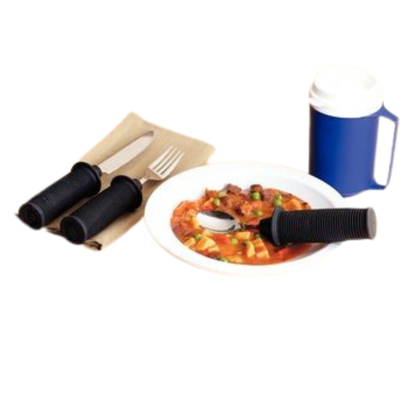
Anti-Tremor Devices for Parkinson's Disease
If you are looking for a Parkinson's device that stops tremors from disrupting everyday tasks, it helps to know what these tools can realistically do. No device removes the underlying condition, but the right one can help reduce and steady hand shaking at mealtimes and beyond. To learn more about the condition first, read about how Parkinson's disease progresses.
Hand tremor devices support the daily tasks that shaking makes difficult, such as eating, drinking, and holding objects steady. This collection brings together the Parkinson's tremor device options from Pisces Innovation, so patients, families, and clinicians can compare them in one place. Each device targets a specific everyday challenge, from steadying a spoon to supporting self-feeding.
The range covers three main categories:
- The Steadi-3 Plus anti-tremor glove is an FDA-registered Class I medical device that uses passive, battery-free vibration damping to help reduce hand shaking. Its clinical testing referenced the Fahn-Tolosa-Marín scale and the Archimedes spiral test.
- The Gyenno Bravo Twist tremor-stabilizing spoon uses motorized stabilization to detect and counteract hand movement in real time during meals.
- Assistive eating and drinking devices support people whose tremor or limited hand and arm function makes holding a utensil or cup difficult.
Many people search for a device to stop Parkinson's tremors. The realistic gains are practical ones: more independence and dignity at mealtimes, and less pressure on caregivers who often help with meals.
Choosing between them starts with the condition and what the person can still do. Parkinson's disease and essential tremor can look similar but are different conditions, and our explainer on essential tremor and Parkinson's is a useful companion. Generally, someone with hand tremor but good arm control may suit the glove or spoon, while someone with limited arm function may need an assistive eating or drinking device. An occupational therapist can help confirm the match. Simple weighted utensils are another passive option some people try first, while an electronic spoon actively counteracts movement.
Pisces Innovation is the exclusive authorized US distributor of the Steadi-3 Plus, backed by 15+ years of service to VA hospitals. The Steadi-3 Plus carries a one-year warranty, and select items are available as FSS Contract Items for institutional buyers. If you would like to talk through which option fits your situation, our team is here to help.
Frequently Asked Questions
An anti-tremor device is a wearable or handheld aid that helps reduce or counteract shaking so daily tasks feel easier. Some approaches are passive, such as vibration damping in the Steadi-3 Plus glove, while others are active, such as motorized stabilizing utensils. These devices help manage and reduce tremor. They do not eliminate Parkinson's disease or the underlying cause of shaking, and the right choice depends on the individual.
Devices fall into two broad groups: those that steady the hand itself, such as a wearable anti-tremor glove, and those built around one task, such as a stabilizing spoon for meals or a powered drinking aid. Thinking about which daily task is hardest is a useful way to narrow the field, and comparing the products in this collection side by side can clarify the differences.
Yes, it can for many people. A motorized stabilizing utensil detects hand tremor and counteracts it in real time to steady the spoon. Gyenno reports that the Bravo Twist tremor-stabilizing spoon reduces shakes by up to 85% compared with a normal utensil. It also logs tremor data that you can share with a physician. Results vary by person and tremor severity.
Depending on the device, support can extend beyond meals to everyday tasks such as holding a cup steady or writing. For caregivers, a better-matched device can mean fewer tasks that need hands-on help, and some people feel more at ease sharing meals with family and friends. Because each person's tremor and remaining hand function differ, benefits depend on matching the right device to the individual.
Start with what the person can still do. Consider where the difficulty shows up most, whether in one task like eating or in many tasks across the day, and whether the person prefers a wearable aid or a dedicated utensil. Also consider whether the goal is general hand stability or independent self-feeding. Occupational therapists often help match equipment to need, and our article on the OT role in tremor management explains how.

ELISpoon


Gyenno Bravo Twist Tremor-Stabilizing Spoon

HandSteady Rotatable Handle Cup

Steady Spoon